

We are living in an era where the speed of globalization is faster than ever before in human history. Over the last few decades, the way motorized vehicles and the internet spread their reach, they opened new dimensions for globalization. We can see this in trade, jobs, education, tourism, and many other areas. Interaction and communication between different civilizations are not new; what is truly never seen before is the speed at which it occurs.
Along with this, a fear is also spreading its reach at the very same speed – the fear of losing one’s own culture. Although this fear has been among us for centuries, it is now taking new forms. For centuries, human civilization lived and breathed in communities across forests, mountains, villages, and towns. Every group shaped and nurtured its own culture based on the local air, nature, land, climate, resources, animals, food sources, and even diseases.
For many of these cultures, globalization or intercultural exchange has settled into people's minds as an existential threat. The results of this fear can be seen in society as cultural clashes.
To understand these cultural conflicts, we can categorize society into two distinct cultural structures in terms of diversity.
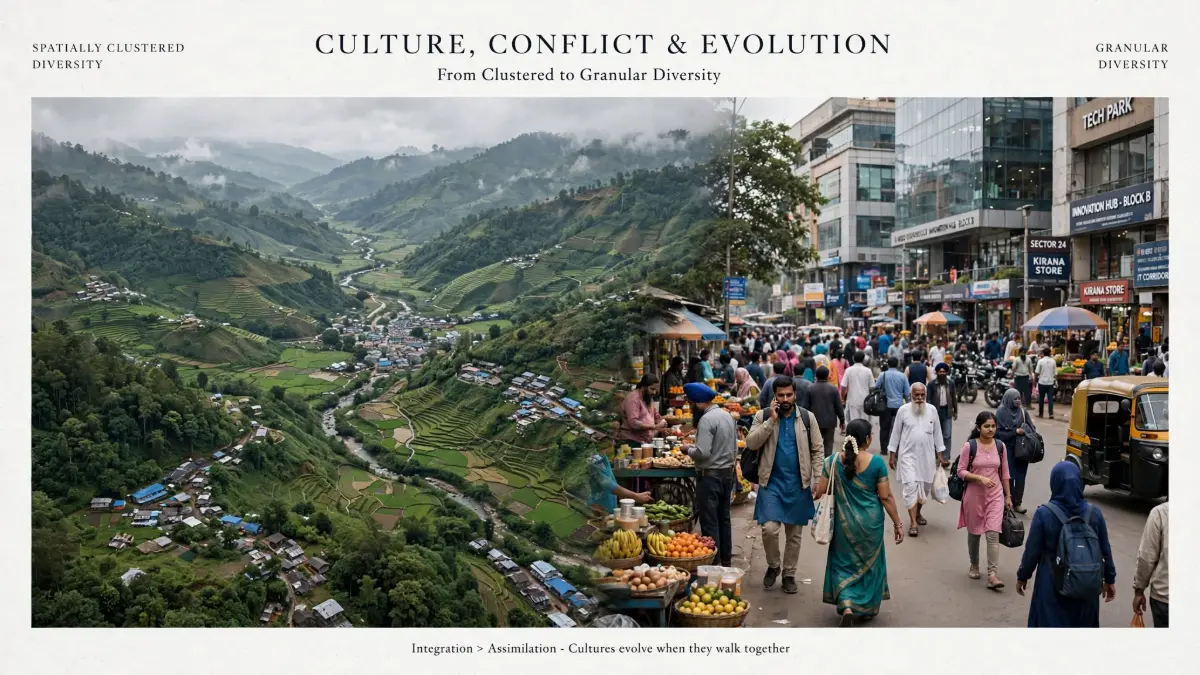
Spatially Clustered Diversity: This happens when two or more distinct cultures live in separate parts of the same region. This clustering can happen at different levels: across a country, state, or within districts, towns, and neighbourhoods.
Over a long period of time, shaped by wars, local migrations, the search for food, and tribal movements, these groups settled down in their areas. Today, they have all become an inseparable part of the land, just like they have been there from the very beginning.
For example, in Sri Lanka, the Sinhalese live mostly in the south, west, and centre, while Sri Lankan Tamils live mainly in the north and east. In Manipur, India, the Meitei community lives in the central valley, while the Nagas and Kuki-Zo live in the surrounding hills.
Granular Diversity: This happens when people move to a region either temporarily or permanently because of rapid urbanization, industrial growth, and migration from other parts of the country or world.
These people do not stay separated in one single corner. Instead, they spread out across the entire area based on their jobs and living needs, often shifting locations as their needs change. This is common in major Indian cities like Noida, Greater Noida, Gurugram, Bengaluru, Hyderabad, Pune, and Mumbai.
Instead of building an isolated community in one separate spot, they live right alongside the local native residents. In many cases, their numbers even grow larger than the original local population.
Culture & Its Evolution
Culture also follows the law of evolution. This means a culture that is centuries old is not the same today as it was in the past. Over time, many different factors come together to help every culture evolve. While a culture keeps growing on its own, something bigger happens when multiple cultures meet. When different cultures walk together and adjust with one another, new paths of evolution open up.
No existing culture is pure; every culture is a mix of several cultures.
To understand this better, we can look at the research on multicultural societies by Canadian psychologist John Berry. His work describes four acculturation strategies that are possible when two cultures meet in the same geographic area:
Assimilation: Giving up your own culture to blend into the new one.
Marginalization: Losing your original culture without belonging to the new one.
Separation: Keeping your own culture while avoiding contact with the new one.
Integration: Holding onto your roots while actively taking part in the new culture.
His research helps us understand the different paths through which today's cultures have taken shape. Among these, when groups live in contact with each other while keeping their identity intact (Integration), cultures do not disappear. Instead, they grow richer, and people can live together with more peace and confidence.
Core Conflict
When we say "culture," it is an umbrella term that includes many small and big things – like language, clothing, art, religion, beliefs, customs, philosophy, festivals, music, dance and daily lifestyle. Among these, some things attract interest from other cultures, while others become reasons for conflict.
Language, philosophy and religion have historically been the biggest drivers of conflict. On the other hand, things like art, dance and music usually spark curiosity and mutual appreciation. Then there are things that cut both ways – becoming a source of curiosity in some cases and conflict in others, such as architecture, clothing and festivals, etc.
Across the world, efforts are being made to reduce these conflicts so that different cultures can interact more smoothly and learn to respect each other. But before moving forward, we must ask: why do these conflicts happen in the first place?
To put it briefly, conflicts arise from:
Believing one's own race is superior to everyone else (as in Nazi Germany).
The fear of losing one’s own culture and identity (as seen with Sri Lankan Tamils).
Government negligence, failed plans, or forced policies (as seen in the Indian state of Manipur).
Political instrumentalization, where cultural identity is used as a tool for power.
All these factors along with few more give rise to xenophobia, which spreads fear and hatred down to the level of the common person.
If we look deeper, these conflicts mainly emerge from the two types of social structures we discussed earlier: Spatially Clustered Diversity and Granular Diversity. Now, let us try to understand which kind of conflict arises from which structure.
1. Cultural Hegemony and Forced Assimilation
When a majority group or ruling power tries to force its language, religious beliefs, or traditions onto minority or vulnerable groups, it creates a deep fear within those communities of losing their existence. This attempt to turn diversity into forced uniformity creates resentment and division. This can be seen in spatially clustered diversity. A direct historical example of this is Sri Lanka’s Official Language Act (1956), which imposed the Sinhala language on Tamil speakers. As a result, the Tamil community was steadily marginalized, laying the groundwork for decades of civil war, terrorism and violence.
2. Unequal Distribution of Resources (Structural Inequity & Competition)
Cultural conflicts are not just about ideas; they are also about control over economic and physical resources. When land, natural resources, government jobs, and development projects are not distributed fairly, different communities start viewing the situation as a zero-sum game – where one group’s gain is seen as another’s direct loss. This can be seen in spatially clustered diversity. A strong example is the Indian state of Manipur, where long-standing disputes between the Meitei and Kuki-Zo communities over Scheduled Tribe (ST) status, hill land rights, resource distribution, and administrative representation escalated into violent conflict.
3. Rapid Demographic Shifts and Fear of Identity Loss
When fast-paced industrialization and urbanization cause a sudden rise in migrant populations within a region, native residents often fear losing their language, culture, and local influence. This cultural insecurity leads to demands for strict local policies and quotas. This can be seen in Granular Diversity. For instance, in Maharashtra, India, the pressure of large-scale migration has driven persistent social and political movements demanding mandatory Marathi signage, language rules for public transport operators, and job protections for locals.
4. Political Polarization and the "Us vs. Them" Divide (Political Instrumentalization)
Political parties and interest groups often weaponize religious, linguistic, and ethnic differences for electoral gain and vote-bank politics. Instead of addressing real socioeconomic issues, they magnify historical grievances to create an "us versus them" mindset. This can be seen in spatially clustered diversity. In India, at the national level, this dynamic is visible in political campaigns that exploit religious or ethnic divisions for voter mobilization; Manipur and Uttar Pradesh(India) are examples of this.
5. Digital Echo Chambers and Social Media Polarization
In today’s digital era, cultural conflicts are no longer confined to local borders. Social media algorithms prioritize provocative, anger-inducing content because it drives high user engagement. This creates closed echo chambers, fuels polarization, and spreads hostility toward other religions, cultures, and languages. A small local incident or a piece of misinformation can be blown up into a national or religious controversy within hours, occasionally sparking mob violence or riots on the ground. This can be seen in both spatially clustered diversity and granular diversity.
Historical Evidence
Intercultural exchange, communication, and conflict are not new to the modern world; evidence of them can be traced back to ancient and medieval times. We also find clear archaeological and historical evidence of efforts toward multicultural harmony, such as the 12th Rock Edict of Emperor Ashoka in the 3rd century BCE, and Emperor Akbar’s inclusive vision in medieval India.
History shows that when different groups interact over long periods, cultures do not destroy each other. Instead, they learn from one another and create entirely new traditions. A prime historical example is Gandhara art, which blended Greek sculptural styles with Buddhist themes – standing as living proof of cultural evolution.
When examining history, language has often been one of the biggest drivers of cultural friction. Every distinct community developed its own spoken dialect and, over time, codified its own script. History shows that forcing a language on people or making careless linguistic policies has repeatedly triggered widespread public anger, sometimes escalating into violent conflict and civil unrest – as seen in the tragic trajectory of Sri Lanka, or the enduring language tensions between North and South India.
The Real Threat
If cultures do not disappear simply by "living together," then a question naturally comes to mind – what actually destroys them? When we look closely, the answer is not diversity. Cultures are rarely killed by their neighbours. Instead, they become weak when something breaks the bond between people and their way of life. This can happen in four main ways.
Forced Suppression: This happens when a dominant power decides that another culture should not exist. Sometimes it comes through war and violence. But more often, it comes quietly – through laws, schools, and government policies that give importance to one language, one religion, or one version of history, and slowly push everything else aside. In Berry's terms, people are forced into assimilation, or even worse, marginalization, where they lose their own identity and are still not accepted by the new one.
Loss of Land: Every culture was born in a particular place. Its festivals follow the local seasons, its food comes from the local soil, and its stories are connected to the local rivers, forests, and hills. When people are separated from their land, whether because of environmental damage or forced displacement, the culture loses its roots. It may survive for some time as a memory, but slowly it loses the ground that gave it meaning.
Rigidity: Sometimes a culture gets harmed by trying too hard to protect itself. When a society closes its doors and refuses to change, it loses the ability to adapt when the situation around it changes. Freezing a culture in the name of purity does not save it. Instead, it makes the culture less relevant for the next generation, and in many cases, they leave it behind completely.
Quiet Erosion: In today's world, the biggest threat is neither violence nor isolation – it is neglect. A tradition starts fading when it no longer supports the people who carry it forward, like a craft that cannot earn a living, or a language that does not help a child get a job. And even when a tradition survives, it can become hollow from inside – turned into a performance for tourists or a product for the market, keeping its form but losing its soul. In such cases, nobody destroys the culture directly. The chain between generations simply breaks.
Now, what about globalization – the fear we started with? It does put real pressure on local cultures, especially on the language and choices of the younger generation. But cultures have always absorbed outside influences and made them their own. Global contact becomes a threat only when it meets the forces discussed above – when a culture is already suppressed, uprooted, frozen, or left behind economically.
Conclusion
In the end, we can say that cultures grow by sharing plates, not by fighting over land. When two cultures come together in the same place, some tension is natural – different languages, different habits, different ways of living. But when this tension turns into conflict, culture alone is rarely to blame. More often, the conflict grows out of poor policies, government negligence, and the unfair sharing of resources. It is fed by the fear of losing one's own culture, by the xenophobia that this fear creates, and by leaders who use identity as a tool for power. Culture becomes the face of the conflict, while the real causes stay hidden behind it.
And this is not something new. It has been happening for generations, across every part of the world. History shows us both sides of the story. Where cultures were forced, divided, or ignored, the result was resentment and violence. But where they learned to accept each other, both of them grew richer than they could ever have grown alone.
So the fear of losing our culture by meeting others is, in many ways, misplaced. Meeting others has never been the danger. When cultures sit at the same table and share their food, their festivals, and their stories, they do not lose themselves – they grow, together.