

Today, almost every organization, big or small, is trying to organize or promote intercultural dialogue. But why? Why is it needed? What is the expected output?
Before moving forward and taking part, you might wonder about this question. Even if you have not, it is still good to know the answer.
Actually, this is not happening for the first time. For centuries, this demand has come up again and again, and practical actions were also taken to address it. Clear evidence of this can be traced from mythology through ancient and medieval history.
When different groups of people live in separate regions, they shape their cultures around local resources and conditions – something we explored in detail in our previous article on cultural diversity. But when these cultures come into contact through trade, education, employment, regional migrations, or other factors, several outcomes begin to unfold. At the same time, we examined the darker side of this interaction: xenophobia, targeted hate, political weaponization, forced assimilation, and even genocide.
In that article, we also saw that when multiple cultures interact and work alongside one another, they do not simply vanish; instead, they evolve and innovate at a much faster pace. Because human civilization is thousands of years old, history offers no shortage of examples for both sides of this coin. Recognizing the gravity of these tensions, rulers, philosophers, and social reformers across eras took deliberate steps to build mutual understanding, encourage open communication, and maintain social harmony between different communities. What we see across the globe today as intercultural dialogue is the direct, modern continuation of those very efforts.
As mentioned earlier, the need for intercultural dialogue isn't a modern idea; ancient history recognized it just as deeply. A clear example comes from 3rd-century BCE India with Emperor Ashoka’s 12th Major Rock Edict. Ashoka urged people to listen to and learn from the core ideas of other faiths. He believed that making an effort to understand different viewpoints would make society "Bahushruta" – well-informed, thoughtful, and wise. For him, mutual respect wasn't just passive tolerance; it was an active duty. The same can be seen in medieval India, where Mughal Emperor Akbar (1556–1605) took a similar hands-on approach to cross-cultural dialogue through two main efforts: The Ibadat Khana (House of Worship), an open forum where thinkers, theologians, and leaders from different faiths – including Hinduism, Islam, Christianity, Jainism, and Zoroastrianism – could discuss ethics and philosophy on equal ground; and The Maktab Khana (Translation Bureau), built on the belief that ignorance of other cultures causes fear and conflict. Here, major Sanskrit epics and texts like the Mahabharata, Ramayana, and Atharvaveda were translated into Persian, making core traditions accessible across community lines.
And this is not the end. There is plenty of evidence, from the Upanishadic period to Modern India where many kings or communities promoted intercultural dialogue. And this is what we continue to promote for betterment of societies or civilization as well as to overcome the conflicts due to cultural diversity.
We also understand the need for intercultural dialogue because cultural diversity is a universal truth that cannot be removed, erased, or ignored. So, rather than opposing this stream, it is much wiser to accept it and flow along with it.
Every culture and faith contains its own truth or is on the path toward it, which is how any goal is ultimately reached - by stumbling, losing one's way, standing back up, and walking again. History shows that cultural conflicts often end in demands for new nation-states or combine with other factors to result in severe genocide. While this does not happen overnight and cultural diversity is rarely the sole cause, it frequently becomes the foundation or face upon which these conflicts build. What is the purpose of drawing new lines on a world map when, even after creating a new country, we still must engage with one another through trade, employment, tourism, education, and social relations? Will drawing lines on a map truly eliminate hatred? No. That is why it is essential to minimize these conflicts as much as possible, and the most effective tool for doing so is dialogue. Although results will not appear overnight or within closed rooms, if we never begin, how will we ever reach our destination?
The key is to keep moving forward until that truth or goal is reached that every culture is trying to achieve. Every culture has its own distinct traditions, attire, practices, faith, and beliefs, yet their foundational values remain the same: compassion, peace, honesty, charity, humility and duty. If the core values of every culture and civilization are aligned, why do so many conflicts still arise?
Conflict is not a bad thing; it is part of growth. Two intelligent people will not always agree on the same points and this is where the conflicts start, but this could be the reason for discussion; not the hate, phobia, or division of humanity. And yes, the real problem is the hate, the war, the xenophobia, the political instrumentalization, the ignorance, the genocide due to these conflicts.
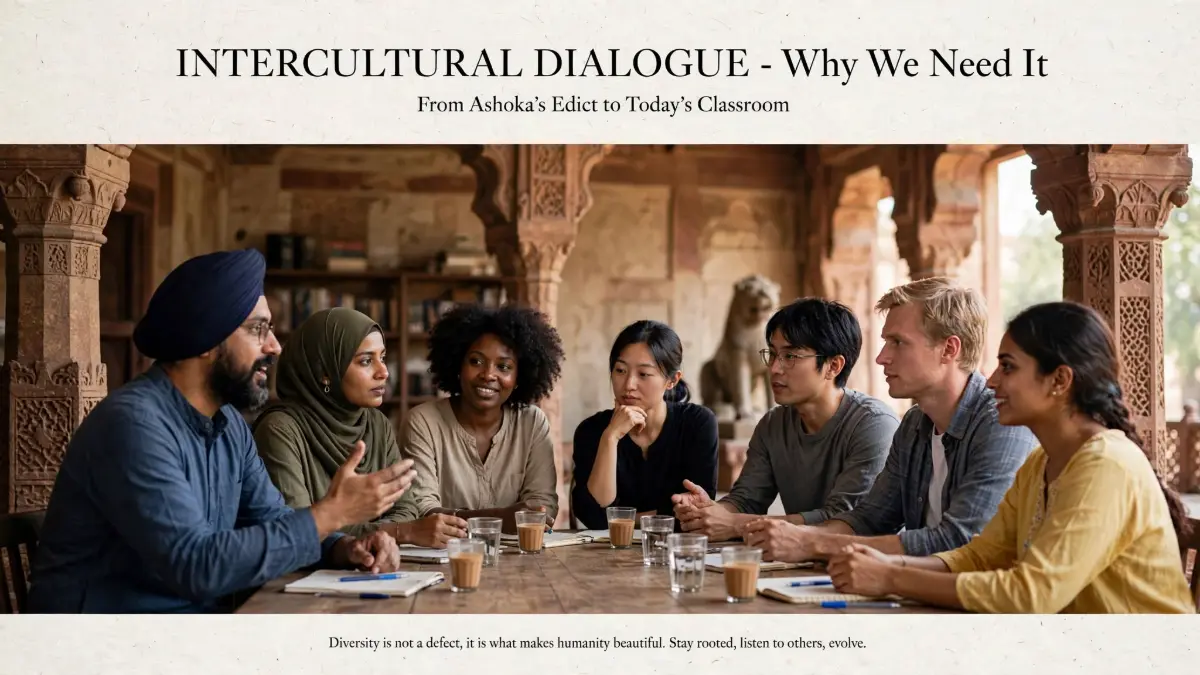
To overcome these conflicts, let us come together under the same roof by keeping our cultural diversity intact and accepting the presence of others and discussing ideas of philosophy, society, humanity, mythology, liberty and more.
All these efforts are meant to build a better world where people will not fight with each other due to their cultural diversity, nobody will suffer from xenophobia, no Hitler can come to instrumentalize the cultures or race, no genocide in the name of cultural difference.
Diversity is not a defect of humankind; in fact it is what makes it beautiful and interesting.
Remaining rooted in one's own culture while engaging respectfully with neighboring cultures, listening to them, and honoring them is the core responsibility of every culture. This is what enables a culture to grow and evolve; otherwise, it eventually fades away over time.